
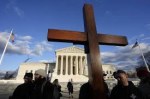
This interview conducted by Crossway caught my attention. It has to do with the institutional church, its spirituality, and Christian nationalism. My interest is limited to how the institutional church, which is made up of many members, is to relate to temporal yet lawful institutions in the world.
I find two quotes from the interview to be a bit puzzling.
“No other institution is called to go into all the world and preach the gospel. The family? No. The state? No. The university? No. The publisher isn’t called to go into all the world and preach the gospel. That call is given to the church. And if the church becomes chiefly a political, economic, or social institution, it becomes an institution that is just one more form of kind of shouted political slogans in the cacophony and all the noise of our very polarized politicized age. If the church just becomes that, it loses that voice. It loses its proper agency. It loses its grip and its grasp on the gospel. And if the church loses the gospel, who has it? Where is the gospel? The church is called to preach the gospel to the world.”
Alan Strange
It is one thing for the institutional church to become a political mouthpiece from the pulpit, and quite another thing for the institutional church to posses a proper political zeal in the world. It seems somewhat obvious that one size doesn’t fit all.
A Christian congressman who spends fifty hours a week embroiled in the political battle for the life of the unborn, or defending the rights of the oppressed, can be running God’s errand. Yet it’s hard to apply the same balance of work and life to the institutional church’s pulpit ministry. Consequently, phrases like “the church becomes chiefly a political…”, and “the church is called to preach the gospel” should connote different meaning, with vastly different contextual demands, depending upon the respective callings of the many members of the one institutional church.
Back to basics:
The institutional church is comprised of individuals who gather on the Lord’s Day and then scatter into the world to live out their respective callings before God. Consequently, the institutional church’s primary ministry on Sunday is not to reform the institutions of this world, or even reach the world for Christ, but to build up the saints in their worship of God. To that end, it is primarily on Sunday that the church’s members become equipped to fulfill their respective callings in the world, which includes (a) the mission work of the institutional church as well as (b) bringing biblical precepts to bear upon the ideologies of political, economic, and social institutions.
Institutional church members hardly can avoid interacting with, if not even being members of, other institutions such as family, civil government, and education. Accordingly, the institutional church’s members must be equipped to pull down the philosophical strongholds of the age lest they become (a) fideistic (b) impotently silent in her witness and / or (c) taken captive by the elementary principles of the world. To that end, there is a Christian duty to be able and willing to disarm the enemies of God, not just with kindness but a winsome word in season that has the power to tumble the institutional gods, if not at least silence their idolatrous worshippers.
Leaving aside how a minister of the gospel might train its congregation to think biblically in all areas of life (yet without hindering the church’s spirituality), as a general rule we might hope that the minister’s Sunday sermon would be heavier and more exhaustively focused on exegesis and indicatives, and perhaps lighter and more generally focused when it comes to personal application and imperatives regarding influencing the institutions of this world. That should be a given.
Admittedly, men like Jerry Falwell and D. James Kennedy likely lapsed into seasons of spiritual amnesia regarding their gospel-calling by turning their focus toward civil and political interests. Notwithstanding, such spiritual infidelity does not so neatly apply to the church’s members who on Monday morning scatter into the world in the service of the church militant. Indeed, when all is well, we can expect the church’s message on Sundays to look vastly different from its members’ message(s) the other six days of the week. Need it be even said that the minister who is preaching to his congregation the riches of the first fourteen verses of Ephesians has a different set of providential constraints and freedoms than the Christian plumber who is changing out a hot water tank, or the Christian businessman who accepts an invitation for a beer after work with his politically minded and irreligious colleagues? Simply put, ministers of the gospel preach their Christian message to believers on Sundays in a sabbath context, whereas throughout the week the institutional church’s members not only live out but, also, verbally communicate an applicable message to the lost, which ideally flows out of principles gleaned through Sunday pulpit ministries. That is to say, the context for Sunday preaching and that of the balance of the week are vastly different, and so we would expect the institutional church’s members’ message to be too, even as they go into all the world to live for Christ.
Lest I am misunderstood, there is a relevant difference between pulpit polemics and Christian apologetics, or a plumber being honest with his clients and a pastor being true to the text as he preaches election, forgiveness, adoption and the hope of glory. And although the gospel of salvation from sin never changes, even in New York City(!), what is not a constant are the various callings and demands within the one institutional church that fall upon its many members. Those demands can often include discussing politics or even bringing biblical precepts to bear upon sundry institutions, including the civil magistrate.
Members bring the institutional church’s message in the world:
When a Christian husband who is the president of a university bears witness to Christ in the world, he does so as an ambassador for Christ and a member of his body. His faithful testimony, insofar as it is faithful, is consistent with that of the institutional church. It might also be in unison with his university and, of course, the family he heads. But it is the message of the organism of the church that infiltrates, permeates, and even at times reforms other institutions. So, if the university is a Christian institution, then the witness of the institutional church has succeeded in finding another outlet for her message, (for it is the institutional church’s message that is going forth into the world). Indeed, the church’s message originates with her head! So, in a word, just as Christ’s word has brought forth the church, so it is that the church must bring forth Christ’s word.
“And so Christian nationalism is saying something of that needs to be recaptured. Part of the problem there is I don’t know how you go from our degree of heterogeneity and so pluralistic to what they’re calling for without coercion or violence. There’s no way to do that. You can’t return to Mayberry from where we are without something close to a civil war, it seems to me.”
Alan Strange
I’m no expert on the ununified voice of Christian nationalism, but if it looks like a Westminster civil ethic, then I’m all in on that part. Yet even if they are vastly different in emphasis, anything from the former that resembles the latter is worth preserving.
Civil magistrate and eschatology:
A Westminster civil ethic as it applies to the civil magistrate is not tied to any eschatological bent or the belief that the general equity of Israel’s civil laws will actually be adopted in toto by any particular nation someday. Rather, it’s a matter of what ought to be the case, as opposed to what will be the case. With that common misconception aside and recognizing that coercion is the duty of the state(!), why must the only options be coercion, violence or civil war? I hope that is not a necessary inference drawn from Christian nationalism! But even if it is, why would one who opposes Christian nationalism find it difficult, let alone impossible, for God to bring to pass certain laws through a massive spiritual conversion of the citizens of the United States, or at least the conversion of the preponderance of America’s politicians and judges? One can even cling to a pessimistic amillennialism and acknowledge the possibility of such laws being implemented in America. After all, Americans make up only five percent of the global population. Accordingly, the possibility of such laws obtaining in America is possible even from a doom and gloom end times perspective. The only question is whether such an achievement is too big for God! At any rate, is there a Christian reason to think that the the implementation of such laws in America is only possible through ill gotten means that involve manipulation or death? That mindset seems more atheistic than Christian. More alarmist than sensible. At the very least, let’s not forget that Christ’s people will become willing in the day of his power, as Christ from the right hand of God strikes through kings in the day of his wrath. (Psalm 110:3,5)
Not just the gospel:
The apostle Paul declared the whole counsel of God while resolved to know only Christ and him crucified. We can reconcile the paradox by understanding the hyperbolic import of the latter sentiment. At the heart of the norm of norms that is not normed is the gospel. In other words, the treasure trove of riches contained in the whole counsel of God is rooted in the profundity of the message of the cross. Not only is all wisdom deposited in Christ – the gospel is not antithetical to political activism; the two happily comply as the former informs the latter. Although our citizenship is in heaven, all kings must kiss the Son to stay his anger. (Psalm 2)
In final analysis, if we’re talking about pulpit ministry, then of course placing the accent on the state’s allegiance to Christ is a misplaced agenda. Is that what this is all about? No, the present context is not the pulpit but the institutional church going into the world with the spiritual message of Christ. If we’re talking about members of the institutional church in their respective callings in the world, then a practice of political fervor would be a matter of conscience and an application of the normative principle of life (i.e., whatever is not forbidden is permissible). But if we’re talking about the formal sending of missionaries into the world, then is there something I’ve missed? Are we seeing the church’s missionaries leading with politics, the civil law or some stripe of Christian nationalism? Is that what this is all about?!
Indeed, that Christ has authority over the state is part of the whole counsel of God. Whether an individual wants to lead with that doctrine is a matter of liberty and wisdom. Personally, I have often found myself reminding many who share my view of the civil magistrate that our kingdom is not of this world. Of course, I adopt a different approach when talking with Reformed antinomians. Lately, that approach has been pure avoidance of the subject.
In closing:
Let’s step back and gain some perspective. When a person’s diet is Rachael Maddow, his thoughts about conservatives will likely be skewed in one direction. Whereas if Tucker Carlson is one’s daily sustenance, his view of Democrats will likely be distorted away from what is true about them. Similarly, if we take the church’s pulse on Christian nationalism from our Twitter (X) feed, we might lose perspective on the average congregant in the pew. (A good exercise might be to consider for a moment whether the average member of the institutional church across the globe was aware of the Trinity debate over the summer of 2016.) We all have a tendency to become myopic. So, let’s be mindful that media outlets are masterful at exploiting our finitude, even our fearful tendencies. We’re all targets and vulnerable.

 Philosophical Theology
One response to “The Institutional Church, Spirituality and Christian Nationalism”
[…] Read More […]
LikeLike